
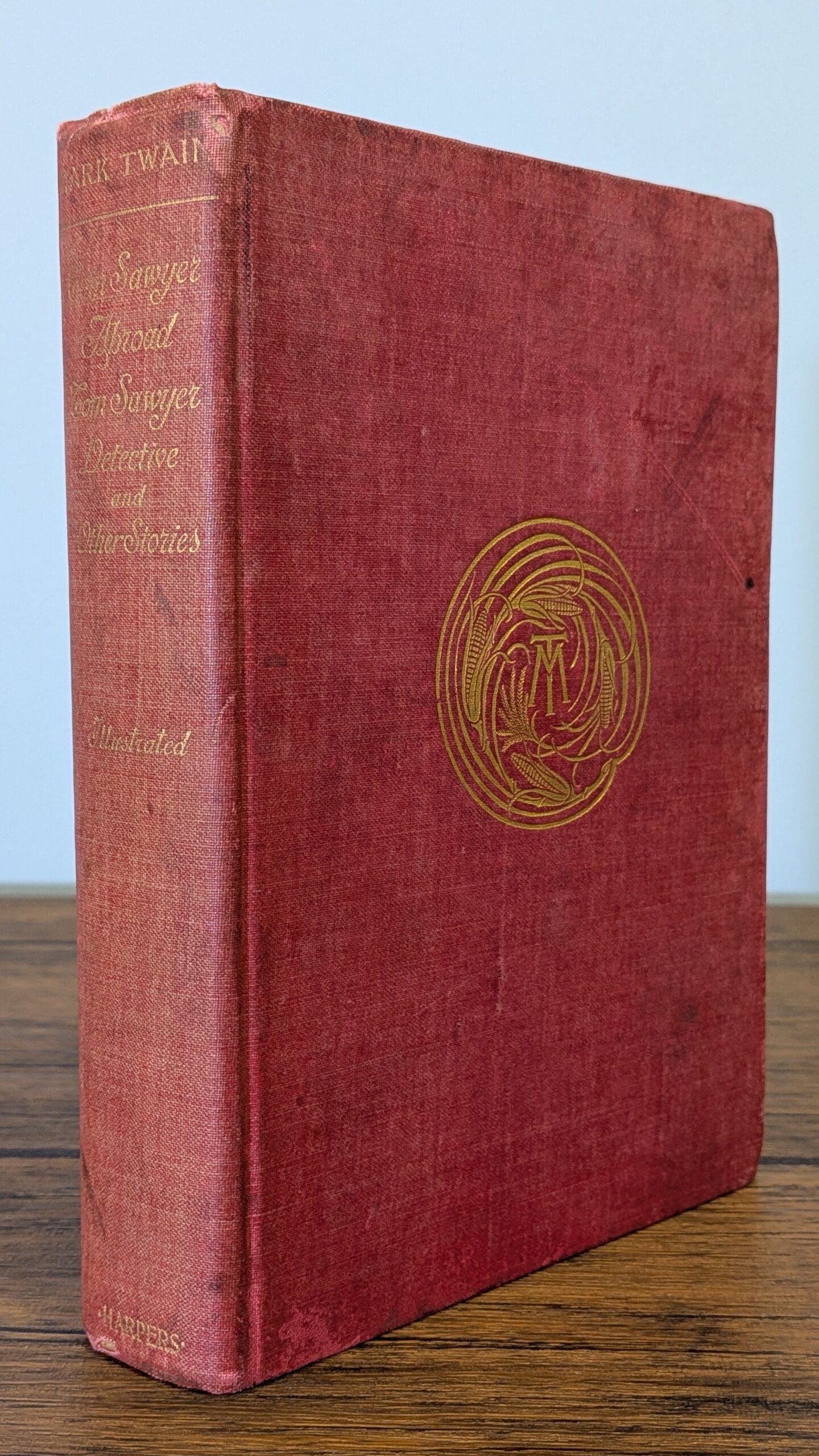
Mark Twain prefaced Tom Sawyer, Detective (1896) with an unusual acknowledgment. Its central incidents, he explained, were drawn from an “old-time Swedish criminal trial,” with the characters changed and the action relocated to America. But there is at least one problem with that explanation: that trial had taken place in Denmark.
Tom Sawyer, Detective, the fourth and final canonical adventure of Twain’s famous fictional duo, picks up shortly after the events of Adventures of Huckleberry Finn (1884). The story, narrated by Huck, opens the spring after Tom and Huck helped free Jim from captivity on Uncle Silas’s Arkansas farm, to which the boys return, with Silas himself becoming the principal suspect in a murder. The narrative owes much of its plot to a real seventeenth-century case involving Søren Jensen Quist, a Danish clergyman convicted of murdering a servant and executed in 1626.
That case had already inspired The Rector of Veilbye (1829), a celebrated work of Danish fiction by Steen Steensen Blicher. His version introduces a remarkable twist: the supposedly murdered servant returns years later, revealing that the clergyman was innocent. This revelation comes too late to save him.
The similarities between Blicher’s work and Twain’s were striking enough to provoke accusations of plagiarism. In 1908, Danish schoolmaster Valdemar Thoresen wrote to Twain questioning the relationship between the two stories. Twain’s secretary, Isabel V. Lyon, responded in December 1908, insisting that the author was unfamiliar with Danish, did not read German fluently enough to read the German translation, and had never knowingly encountered Blicher’s work. She maintained that Twain had never been a conscious plagiarist.
Thoresen nevertheless publicized the similarities in a Danish periodical the following year. The controversy eventually attracted the attention of J. Christian Bay, whose 1929 essay, “Tom Sawyer, Detective: The Origin of the Plot,” remains an important examination of the matter. Bay regarded the two narratives as unmistakably related and concluded that Twain’s confusion in referring to Sweden had no significance. Bay suggested that the novelist had simply used Sweden as a loose geographical shorthand for Scandinavia, confusing the better-known country with neighboring Denmark.
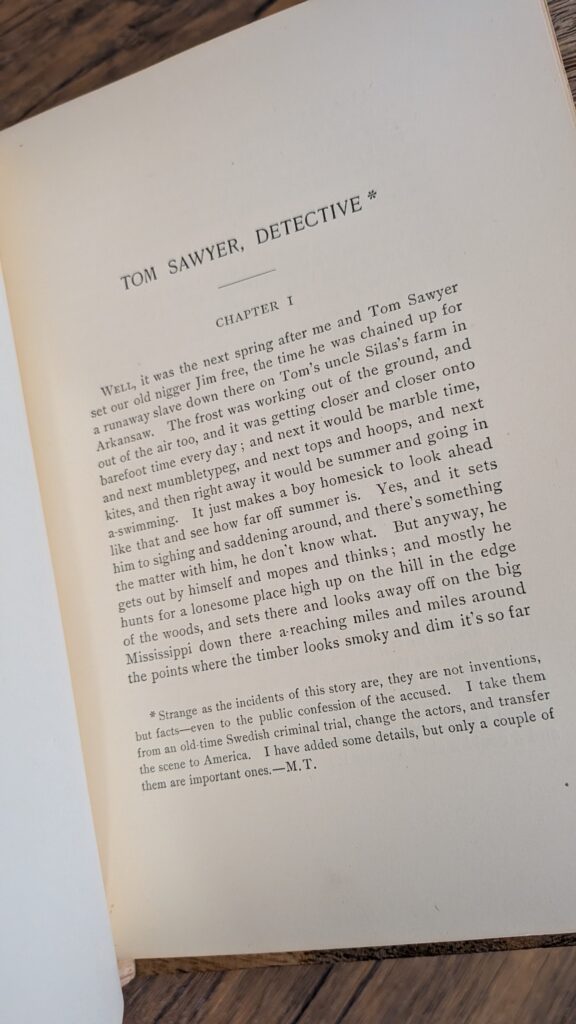
Opening page of Mark Twain’s Tom Sawyer, Detective (1896), featuring the author’s note attributing the incidents of the story to “an old-time Swedish criminal trial.”
“If the story came from a woman then living in Sweden, Twain might simply have associated the location of his storyteller with the location of the events she described.”
It is a reasonable explanation. But Bay’s investigation also addressed a more interesting question: How had Twain encountered the murder case in the first place? Through Twain’s biographer Albert Bigelow Paine, Bay learned that Twain remembered hearing the tale from the wife of a diplomat. Further inquiries later established that the woman was American and her husband a northern European diplomat.
Bay believed he had identified her: Lillie de Hegermann-Lindencrone, a Massachusetts-born singer and writer married to Johan Henrik Hegermann-Lindencrone, a Danish diplomat. In his 1980 introduction to Tom Sawyer, Detective, Twain scholar John C. Gerber placed the telling of the story at a social gathering in Paris around the beginning of 1895, shortly before Twain completed the manuscript. The identification remains circumstantial, but it provides a plausible route by which the Danish narrative reached the American novelist.
And there was a remarkable family connection. Johan Henrik Hegermann-Lindencrone’s grandmother, Louise, had herself written a fictional treatment of the Quist affair. Her story, identified by Bay as The Guest-Room at the Parsonage, appeared in a collection published in 1825—four years before Blicher’s famous work. In other words, the woman believed to have told Twain the story had married into a family with a literary connection to the murder case dating back two generations. Whether she had learned it through that family tradition or encountered Blicher’s version independently is unknown.
But one further detail deserves consideration. In The Sunny Side of Diplomatic Life, 1875–1912 (1914), Lillie de Hegermann-Lindencrone recounts her experiences accompanying her husband through several European diplomatic postings. Among them was Stockholm, where the couple lived from 1890 until 1897. Johan was serving as Denmark’s minister to Sweden throughout the period in which Twain reportedly heard the story.
Could this explain Twain’s curious geographical error? Bay proposed that Twain had confused Sweden with Denmark because he treated Scandinavian geography rather casually. But perhaps the confusion was more specific. If the story came from a woman then living in Sweden, Twain might simply have associated the location of his storyteller with the location of the events she described.
The distinction is small, but intriguing. Twain’s reference to Sweden was not merely an editorial oversight in 1896: he had also identified the murder as having been “committed in Sweden in olden times” in correspondence with his financial adviser, Henry Huttleston Rogers, in January 1895. Whatever the source of the confusion, it was already present when the manuscript was taking shape. We cannot establish that Twain’s geographical mistake arose from Hegermann-Lindencrone’s Swedish residence rather than a more general misunderstanding of Scandinavia. Still, the convergence of dates, places, and family history makes the possibility worth recording.
A seventeenth-century Danish murder inspired two Danish literary treatments, apparently passed through the recollections of an American-born diplomat’s wife living in Sweden, and eventually reached Twain at a gathering in Paris. From there, the story traveled to the banks of the Mississippi, where Tom Sawyer was entrusted with solving the mystery. Its journey was nearly as improbable as the fiction it inspired.
Sources and Further Reading
Bay, “Tom Sawyer, Detective: The Origin of the Plot,” in Essays Offered to Herbert Putnam (1929); Gerber, introduction to Tom Sawyer, Detective, in The Adventures of Tom Sawyer, Tom Sawyer Abroad, and Tom Sawyer, Detective (1980); Hegermann-Lindencrone, The Sunny Side of Diplomatic Life, 1875–1912 (1914).