
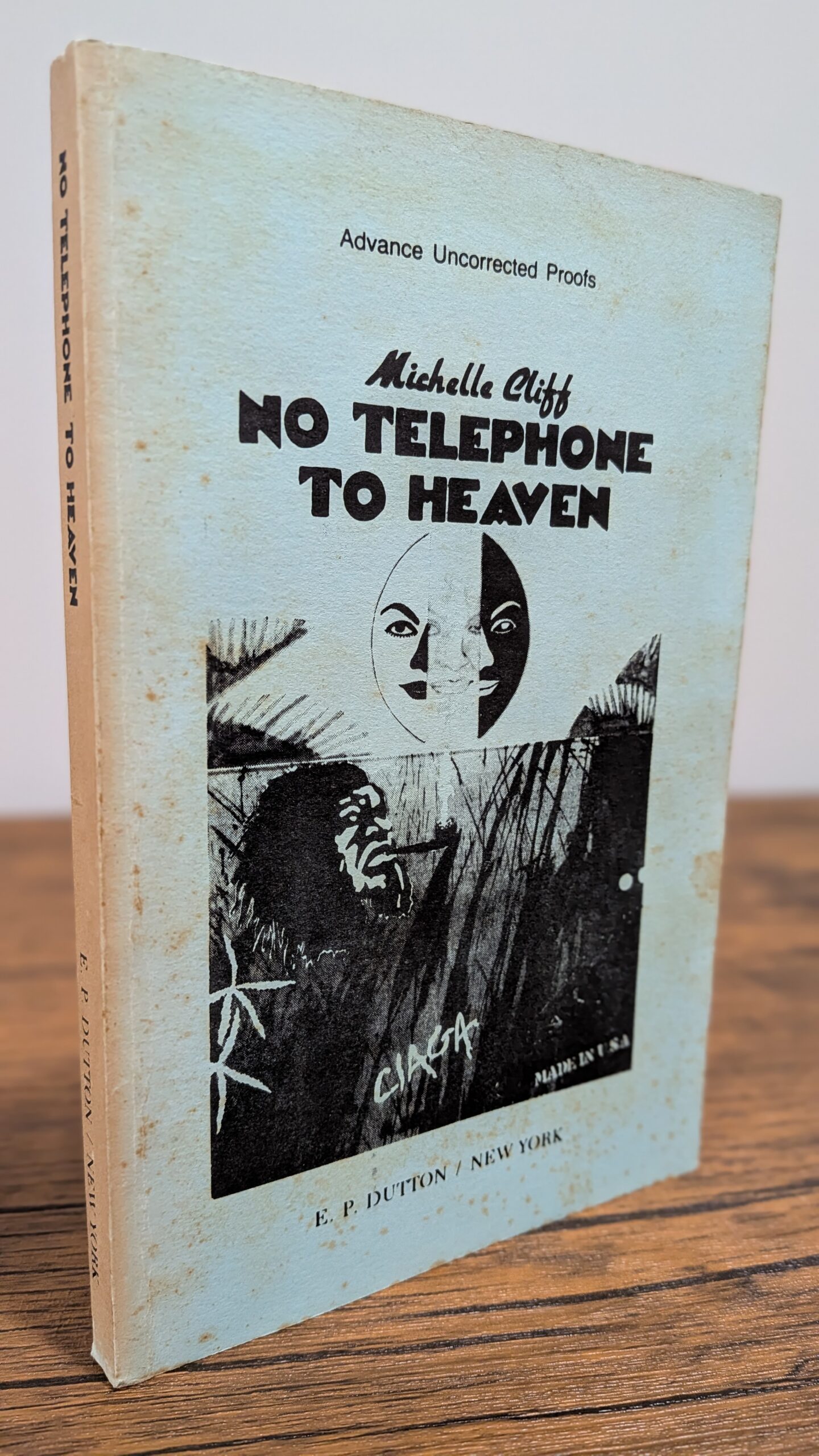
When Michelle Cliff published No Telephone to Heaven in 1987, she placed Derek Walcott in epigraphs at both ends of the novel. An excerpt from the Saint Lucian poet’s “Laventille” precedes the narrative, while a passage from his “Jean Rhys” introduces its final chapter. These selections were part of a much broader paratextual arrangement of literary voices through which Cliff examined Caribbean history, cultural identity, and the authority to tell stories.
No Telephone to Heaven, the sequel to Cliff’s semi-autobiographical debut novel Abeng (1984), continues the story of Clare Savage, a light-skinned Jamaican woman negotiating the legacies of race, class, and colonialism. Clare’s journey takes her from Jamaica to the United States and England before she returns to her homeland, eventually joining a revolutionary movement. Throughout the novel, Cliff resists the authority of the colonial English literary canon by placing Caribbean poetry, Yoruba hymns, and Jamaican proverbs among the epigraphs that introduce her chapters.
The choice of Walcott’s poetry is particularly significant. “Laventille,” originally published in The Castaway and Other Poems (1965), reflects on the enduring wounds of slavery and the Middle Passage. “Jean Rhys,” from The Fortunate Traveller (1981), invokes another Caribbean author whose Wide Sargasso Sea (1966) famously reimagined Bertha Mason, the marginalized West Indian character in Charlotte Brontë’s Jane Eyre (1847). Rhys’s literary reclamation finds an echo in Cliff’s novel, whose protagonist comes to question her identification with Brontë’s English heroine and recognizes herself instead in Bertha.
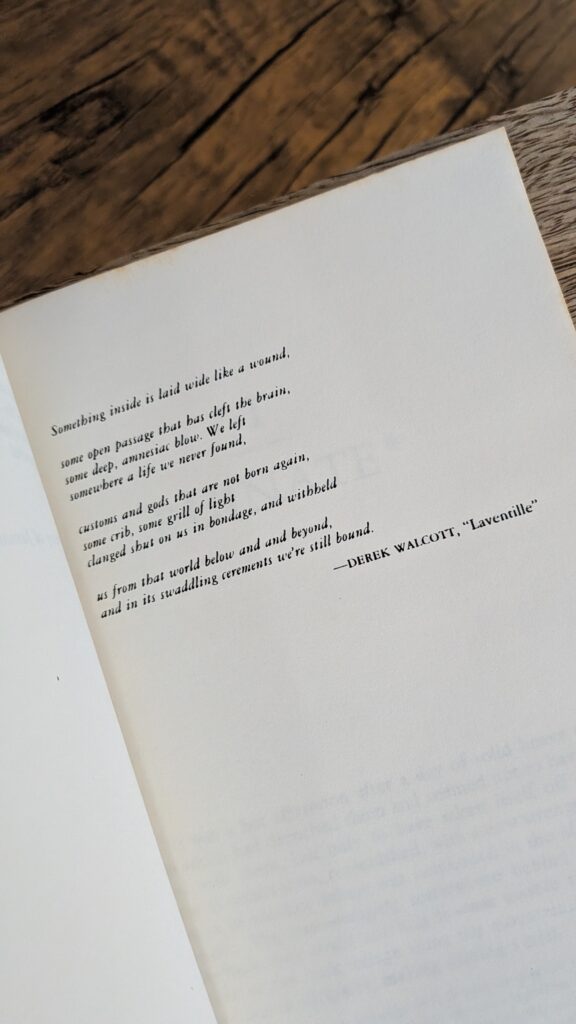
Opening epigraph of No Telephone to Heaven (1987), excerpted from Derek Walcott’s “Laventille” (1965), a poem confronting the historical legacy of slavery.
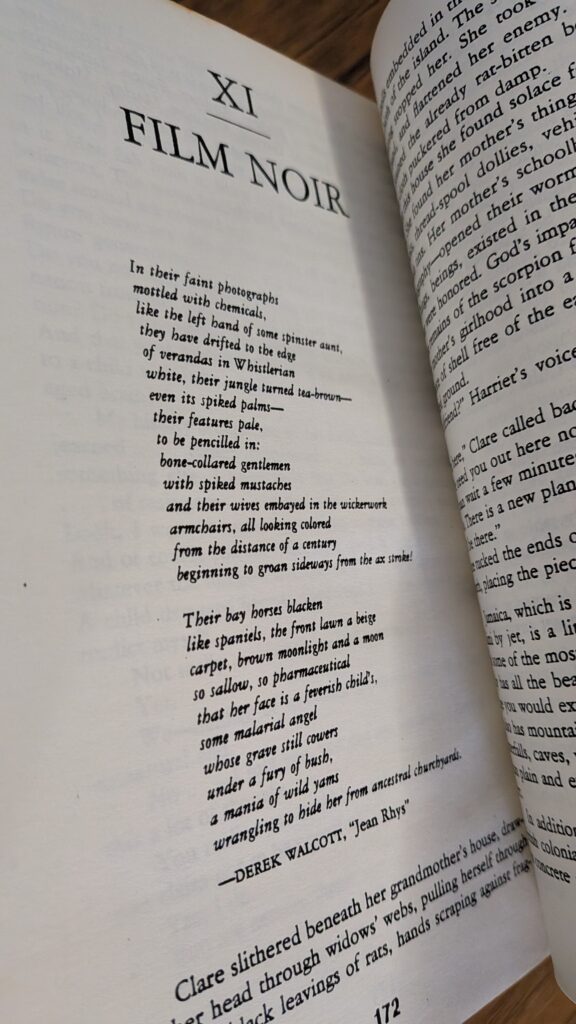
Epigraph preceding the final chapter of No Telephone to Heaven (1987), excerpted from Walcott’s “Jean Rhys” (1981), invoking the Caribbean author of Wide Sargasso Sea (1966).
Scholars have long recognized the importance of the epigraphs in No Telephone to Heaven. In his 1995 essay “After The Tempest: Shakespeare, Postcoloniality, and Michelle Cliff’s New, New World Miranda,” Thomas Cartelli describes No Telephone to Heaven as “one of the few postcolonial works to claim an epigraphic authority for other postcolonial writers and for the traces of postcolonial cultures.” In her 2002 article “Claiming Masculinity as Her Own: Maroon Revolution in Michelle Cliff’s No Telephone to Heaven,” Patricia Krus explains that the novel’s first Walcott epigraph “creates a thematic link between Cliff and Walcott” and that the epigraphs generally underline the thematic relations between Cliff and her predecessors. Krus adds that these intertextual references “let the voices of several ‘parents littéraires’ or mentors be heard throughout Cliff’s text.”
Margaret Grace Love develops this discussion further in her 2020 essay “A Paratextual Threshold: Epigraphs and Postcolonial Literary Authority in Michelle Cliff’s No Telephone to Heaven,” published in Storyworlds: A Journal of Narrative Studies. Love seeks to add a fifth function, to wit, the conferring of authority, to the four functions of the epigraph outlined in Gérard Genette’s Paratexts: Thresholds of Interpretation (1997). Crucially, Love argues that Cliff uses this fifth function to declare her own canon in contrast to the colonial English literary tradition.
In pursuit of this argument, Love claims that Cliff’s Walcott epigraphs make “a dynamic statement regarding her view of the Caribbean poet’s position as a literary authority and the intertextual nature of Caribbean literary expression.” Love explains further that “Cliff presents Walcott as a figure of literary authority that recognizes the amalgam of traditions that influence and inform Cliff’s vision of Caribbean literature, and simultaneously critiques the colonial narrative of British cultural superiority.” Now surfaced is a revealing new piece of contemporary evidence corroborating these interpretations.
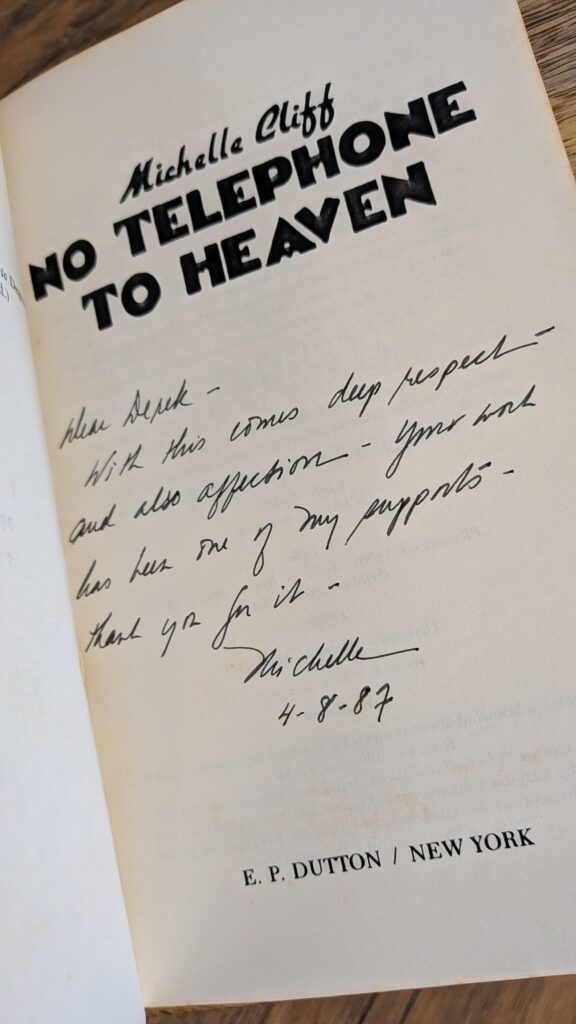
Title page of the advance uncorrected proofs of No Telephone to Heaven (1987) inscribed by Michelle Cliff to Derek Walcott.
“Dear Derek — With this comes deep respect — and also affection — your work has been one of my supports — thank you for it — Michelle 4-8-87.”
A copy of the advance uncorrected proofs of No Telephone to Heaven survives with a personal inscription from Cliff to Walcott. Written on the title page, it reads:
“Dear Derek — With this comes deep respect — and also affection — your work has been one of my supports — thank you for it — Michelle 4-8-87.”
This inscription lends direct support to Love’s interpretation of Cliff’s reverence for Walcott as a literary authority within Cliff’s vision of a Caribbean literary canon. And, indeed, Cliff’s description of Walcott’s work as one of her “supports” recalls Krus’s discussion of literary mentors. Especially compelling given its presence in the advance uncorrected proofs of the novel, this inscription offers Cliff’s own testimony to a premise of Love’s conclusions about Cliff’s use of the epigraph’s fifth function to declare her canon of Caribbean literature.
Importantly, Cliff’s acknowledgment of her gratitude to Walcott need not imply dependence on his authority. Her regard for his work coexists with her own assertion of literary judgment in choosing his poetry to frame her novel. In Love’s reading, that choice represents something more than an act of homage or an attempt to derive authority: it is a conferral of authority on Walcott as a defining voice in Cliff’s canon.
Sources and Further Reading
Love, “A Paratextual Threshold: Epigraphs and Postcolonial Literary Authority in Michelle Cliff’s No Telephone to Heaven,” Storyworlds: A Journal of Narrative Studies (2020); Krus, “Claiming Masculinity as Her Own: Maroon Revolution in Michelle Cliff’s No Telephone to Heaven,” Journal of Caribbean Literatures (2002); Cartelli, “After The Tempest: Shakespeare, Postcoloniality, and Michelle Cliff’s New, New World Miranda,” Contemporary Literature (1995); Beau Booksby’s copy of Cliff, No Telephone to Heaven (1987), advance uncorrected proofs inscribed to Derek Walcott, consulted in 2026.